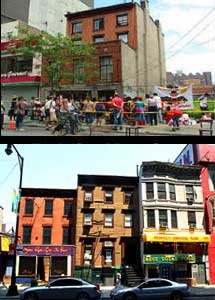
The New York Post, it seems, published a developer's press release without bothering to fact checking. Here is what they wrote about V3 in MORE INN STORE FOR B'KLYN:
Ground will be broken next week on a 19-story, 130-room boutique hotel on Duffield Street between Willoughby and Fulton streets, Long Island City-based V3 Hotels said yesterday.
Three other hotels are already under construction on the same block, and together would bring another 645 rooms. That includes the hip 23-story Hotel Indigo, also built by V3, and new Sheraton and Aloft hotels.
The V3 hotel is expected to open in spring 2011, while the 165-room Hotel Indigo is to be completed by the end of the year.
A few other publications followed suit, including Brownstoner and The Real Deal. The part that is off-base is the completion date of Hotel Indigo, which is planned for 237 Duffield Street. Here are photos dated June 19, 2009. :
Apparently the scaffolding at 237 Duffield has come down in recent days, suggesting that the end-of-year completion date is pure fiction. When the hotel was first announced in 2007, it was slated to be completed at the end of 2008. Here is the Brownstoner post from August 2007.
These pages tell stories about the Underground Railroad in the Capital Region of Upstate New York, and in upstate eastern New York. Why tell that story? First of all because it has been a story that has not received much attention in the general material about the Underground Railroad. Second, it is a story that is important to those of us who live here. But we are telling more than just that story. These pages also focus on the story of the African Americans - both abolitionists and those escaping from slavery whom we call "freedom seekers". It has often been the case in the past that the story of the Underground Railroad was told almost exclusively (with the exception of Harriet Tubman's story) in terms of whites helping African Americans and not often in terms of what African Americans did independently or in leadership roles. These are stories we also focus on. Enjoy the stories recorded in these pages.
In order to promote business, the NYC Economic Development Corporation (EDC) is displacing businesses. Today's example comes from 223 Duffield Street, where A&B Distributors have been thrown into uncertainty. The EDC has bought their building, and now this long-standing enterprise must pay its "occupancy fee ("rent")" to the NYC Department of Housing Preservation & Development (HPD). Of course, since the EDC is so good at economic development, it has not told this business how long it will hold this business in limbo before demolishing the building.
This is all part of the Downtown Brooklyn Rezoning— neighborhood activists have accused the EDC of displacing entrepreneurs and long-time residents without any sort of compensation or plan. A&B Distributors are guilty of several sins, according to critics, since it is both an independent bookstore, and its focus is on African-American literature.
Download a PDF of the letter from HPD here.
This is a video of the proprietor of A&E Distributors:
You can see the same video by clicking here.
Oh, and what does the EDC report from spring of 2007 have to say about this property built around 1847? Below is an excerpt from Appendix B of the EDC report on Duffield, a section submitted by A.J. Williams-Myers, a professor from SUNY-New Paltz and member of the New York State Freedom Trail Commission:
With what Ms. Chatel and Mr. Greenstein have shared, both orally and in a tour of their buildings, as well as the building at 223 Duffield Street, I now need to modify my “no Underground Railroad connection,” and instead indicate a high probability of an Underground Railroad/Abolitionism/Antislavery connection. The Duffield Street buildings, along with the one on Gold Street, are not only situated in the heart of downtown Brooklyn, adjacent to what were known establishments in the Underground Railroad movement, like the African Wesleyan Methodist Episcopal Church on Bridge Street, but 227 Duffield Street housed the Truesdell family which, because of their associations, put them “solidly within the Antislavery inner sanctum.” I left the Duffield Street buildings having been touched by what I saw and upon that which I stood. I saw what indeed may have been the very secreted, below-ground facilities used by those in search of freedom far from the brutal hand of American slavery. And it was the brave souls of the building owners who put their own lives in jeopardy in order to ensure the life and freedom of fellow human beings. I truly stood on ground where humanity joined together against inhumanity.
We hope to provide more information about the historical significance of this building in the coming weeks.
Famoro Dioubate and Missia Saran Diouate of Guinea praise the memory of the Abolitionists who lived at 231 Duffield Street in Downtown Brooklyn. The building was owned by Peter and Mary Hawes of Plymouth Church, and the basement included hidden passages that archeologists think could have provided shelter for escaped slaves during the 1850s. This memorial was held at 227 Duffield Street, which was also owned by Abolitionists and is considered a likely part of the Underground Railroad. 231 Duffield was demolished in March 2009 by a private developer who hopes to build a hotel at the site.
Famoro and Missia are Djelis (also known as Griots), who are the living history books of the Mande Empire of West Africa.
Here are some pictures sent by a reader who identified himself as racer x. The first is an image taken from the ground level from the back of 231 Duffield Street looking down- click the image to enlarge. The wall between 231 and 233 Duffield is on the left:
Here are the pipes in the foreground of the photo above. Notice how they go behind the stone wall towards a brick wall (actual outer wall of property):
The photo below shows the view from above the false wall towards the property line. It shows a gap of about five feet:
Several advocates believe that slaves hid in this crawl space. I have spoken to archeologists familiar with buildings of the mid-19th century, and they had never seen any sort of construction like this.
The demolition of 231 Duffield Street continues. The loss of this Abolitionist home was covered in Brownstoner and Curbed. News 12 Brooklyn sent a reporter, but I haven't seen the clip.
To see an annotated Flicker set of photos from 3/4/09, click here. I have included images of other buildings slated for demolition by New York City.
A few people asked for a photo of 231 Duffield Street before demolition began. Here is something I found from about 2005:
V3 has moved efficiently to demolish 231 Duffield Street. This is demolition is the work of a private developer, and it is NOT the same as 227 Duffield, the Abolitionist home owned by Joy Chatel, who succeeded in lifting the threat of eminent domain on her home.
For more photos of 231 Duffield (plus some nearby properties) on March 3, 2009, please click here. A 6-second video of the back of the building can be found here.
For a brief description of the history of 231 Duffield, click here to read yesterday's post. The demolition of this 1850 home was also covered today in Brownstoner here.
231 Duffield is still standing, but it has been gutted and looks like its shell will only last a few more days at most. Much of the press attention has focused on 227 Duffield (owned by Joy Chatel) and 233 Duffield, but I wanted to take a moment to remember the historical importance of 231 Duffield.
In this memorial posting about the building, I would like to go back to the NYC Economic Development Corporation report titled “Research Report on the Potential Underground Railroad Associations of the Duffield Street and Gold Street Properties in Downtown Brooklyn.” Before getting to the connection to the Abolitionist movement, here's a bit of background:
231 DUFFIELD STREET (BLOCK 146, LOT 13)
Lot 13 originally was part of the John Duffield estate. By 1829, Lot 13 (along with other adjacent lots) had been acquired by John Duffield’s daughter, Susan Lawrence. It appears that Susan Lawrence never developed the lot during the time she held it…. Lot 13 was purchased at public auction for $550 by Robert Dingee of Brooklyn. It appears that lot remained undeveloped during the time that Robert Dingee owned it, from 1847 to 1850. In 1850, Robert and Frances Dingee sold Lot 13 to John A. Ackeley (also spelled Ackley) for $800. Again, the relatively low price paid for the lot suggests there were no improvements to it at the time. After purchasing Lot 13, Ackeley appears to have built the first house on the property after 1850.
One of the Peer Reviewers hired by the EDC in this study was Dr. Judith Wellman. Her widely used Wellman Scale evaluates the significance of potential Underground Railroad sites. A level three is defined as
Good chance the story is true Abolitionist sympathies, abolitionism or African-American background but no direct evidence of Underground Railroad activity. Potential Underground Railroad affiliation backed by oral tradition and/or some evidence of abolitionist activity, e.g., antislavery society membership, signatures on antislavery petitions or antislavery church membership.
In Appendix B page 3 of the EDC study, Dr. Wellman writes:
I would definitely put the Hawes/Hilles household (231 Duffield) at a level three because of the Hawes connection with Plymouth Church and the Hilles family as African American. Similarly, I would put the Truesdale/Harris household (227 Duffield) at level three because of Elizabeth Harris’s birthplace in North Carolina and Thomas Truesdale’s subscription to the National Anti-Slavery Standard. I was not sure about which households several other members of abolitionist churches belonged to. The Truesdales and Hawes families (especially the Truesdales) deserve further work. Level 3 fits people who have some connection with abolitionism, even if there is no documented connection as yet with the Underground Railroad. Membership in abolitionist societies and churches and subscription to abolitionist newspapers would count as abolitionist connections.
Dr. Wellman commented several times in the EDC report about the significance of the 231 Duffield, and Dr. Cheryl LaRoche supported Wellman in her comments.
The demolition of 231 Duffield continues. The whole block was an important part of Brooklyn's Abolitionist history since many of this reviled community lived on the block. The buildings on this side of the block were connected underground. Here are photos from this evening:
Here are photos of the scaffolding that has been erected around 231 Duffield Street. While most attention has been on 227 and 233 Duffield, one important part of the history of the block is that all these buildings were connected underground. 231 Duffield is controlled by the V3, the same company building the hotel at 237 Duffield, and it looks like they intend to use their demolition permit. Some speculate that escaped slaves may have used other buildings on the block for various purposes, but that they stayed in 231.
The Brooklyn Eagle has spread the word about the most recent NYC Economic Development Corporation press release. They report several new details including:
The recently acquired parcels, totaling approximately 23,046 square feet, include 225 Duffield (2,007 sq. ft.) and 223 Duffield (2,107); 116 Willoughby St. (7,500); and 402 (2,000), 404 (2,506), 406 (2,506), 416 (2,189) and 418 (2,231) Albee Square.
Here is Brooklyn Eagle's image of 225 Duffield- 227 Duffield is at the right in the photo. All three properties shown were connected by underground tunnels:
Brownstoner reports on the completion of one of the hotels on Duffield Street:
The 25-story Sheraton is almost done (no word on an opening date but the website says it's "currently accepting group inquiries at the pre-opening office") and its younger sibling next door, the Aloft, has reached five stories. The Sheraton looks pretty nice, we think. Certainly heads and shoulders above some other hotels that have been built in the borough in recent years.
It is my understanding that the hotel was supposed to open last October, which means that it is much more prompt than almost any other large development in the Downtown Brooklyn area.
The article didn't mention a problem that developed a few months ago. Construction of the new hotel undermined the foundation of the building just south, leading to these cracks that go from the bottom to the top of the building:
Brownstoner covers the City acquisitions to create Willoughby Square:
It looks like we were on to something when we reported the city's acquisition of two properties in the Willoughby Square Park footprint earlier this month. Now the rest of the pieces of the puzzle have fallen into place: Public records show that the city has taken title to nine properties through the process of eminent domain. The properties include 392, 402, 404, 406, 416, and 418 Albee Square as well as 223, 225 and 229 Duffield Street. Based on our understanding of how the eminent domain process works, the owners will not receive full compensation from the city until appraisals are completed. A few of these buildings still have some rent-controlled tenants in them who are being relocated by HPD. As for the city's plans for the project, the RFP process for both the landscape design of the 1.25-acre park and the development of the 700-car underground parking garage have been completed but the contracts have not been awarded or announced yet.
The houses, on Duffield Street in Downtown Brooklyn, found themselves the target of the city's eminent domain policy as politicians eyed--er, a parking garage, for the space. Given the economic situation, this one's anyone's call as to how it will end up. Our prediction: Underground Railroad-themed parking garage! Yes? Good?
Nos. 231 and 233 Duffield Street New plans for this block of homes included an Underground Railroad museum and sale of air rights for a new hotel. But negotiations between the owner and developer have stalled, and the project may be scaled back.
67. Abolitionist monuments: The city announced plans to create a $3-million, four-part abolitionist memorial throughout Brooklyn, with plans to start a museum in the former Underground Railroad houses on Duffield Street, set to start in the new year. We’ll believe it when we see it.
There are several factual errors in all these... AMNY should know that 227 Duffield is the most prominent of the Abolitionist homes, and that 233 is owned by a strong advocate of the history. He is not selling, but the developers at V3 have already gotten control of 231 and have applied for a permit to destroy the building.
We do hope, as implied by the Brooklyn Paper, that the city's abolitionist memorial will include Duffield Street. That's not part of the city's plan, but the the groups awarded the contract have the opportunity to include Duffield. Let's hope they do!
I remain hopeful about establishing a museum at 227 Duffield this year. Keep posted for news.