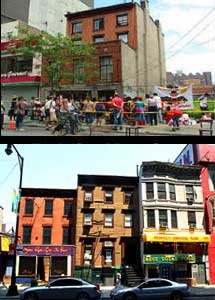
Sunday, October 25, 2009

Voice: Duffield St. is "Best Argument Against Eminent Domain"

The Village Voice published its list of the Best of NYC in their October 21, 2009 issue. Here is what they say on page 26.

Best
Argument Against Eminent Domain
As part of the city's revitalization plans for Brooklyn, an eminent domain notice (seizing property for economic development) was served at a downtown building in January 2004- but the city picked the wrong people to mess with. Owner Joy Chatel fought to preserve 227 Duffield Street. Getting help from (among others) activist Raul Rothblatt, she beat back the threat in 2007. They weren't just fighting for a piece of property, but also a piece of history- the building was home to well known abolitionists and noted by historians as being part of the Underground Railroad. The Duffield collective is raising money to turn the building into a museum, which could become quite an attraction. The fight with the city hasn't ended though: Surrounding buildings, which also have abolitionist history, have been bought up by the city for hotel construction or are under threat of eminent domain. Though they'd like to work with the city, Rothblatt insists that the Duffield group will "fight to the end, promoting and protecting the property."

The Voice ends up by giving a link to this blog- Thanks!

Bk Eagle: Abolitionist History in Brooklyn Gets Fed Grants

The Brooklyn Eagles reports about new support for Abolitionist history in "Project To Commemorate Abolitionist History in Brooklyn Gets Federal Grants":

The Brooklyn Historical Society (BHS), the Weeksville Heritage Center and Irondale Ensemble Project have been chosen to receive two major federal grants to fund their joint project “In Pursuit of Freedom,” a multifaceted program that memorializes the history of abolitionism and the Underground Railroad in Brooklyn.

The U.S. Department of Education Office of Postsecondary Education’s Underground Railroad Educational and Cultural (URR) Program has awarded BHS $936,000; and the National Endowment for the Humanities (NEH) has awarded $400,000 to the program, which was originally announced last year....

These awards complement $2 million already granted by the city in 2008 through a Request for Proposals that was initiated by the Downtown Brooklyn Development Corporation.

The project to commemorate Brooklyn’s abolitionist history stems, at least in part, from a controversy several years ago, over an urban-renewal plan to destroy several 19th century homes on Duffield Street that were reportedly linked to the Underground Railroad. The Duffield Street houses have since been saved.

One of the Duffield Street homes, number 227, was spared in a settlement with the city in 2007. Its owner, Joy Chatel, pledged to continue giving tours of her home and using it as a center where people can learn about the Underground Railroad and abolitionist activity in Brooklyn. Another known Underground Railroad site in Brooklyn is the former Bridge Street A.W.M.E. Church building, now part of Polytechnic University....


All aspects of the project will utilize historic artifacts and documents held by the Brooklyn Historical Society.

Among these are a rare copy of the Emancipation Proclamation signed by Abraham Lincoln; original letters written by Henry Ward Beecher and fellow abolitionist William Wilson; propaganda tracts; numerous slave bills of sale; as well as newspapers, anti-slavery pamphlets from the 1840s; and early photographs of the people and places crucial to the story.


To read the original article, click here.

Wednesday, October 14, 2009

Abolitionist homes saved!!

The Underground Railroad homes on West 29th Street in Manhattan have gotten historic protection from the Landmark Preservation Commission. Here is the an excerpt from "Landmark victory for Underground Railroad block" published in Chelsea Now:

The city Landmarks Preservation Commission enthusiastically approved the historic designation of a dozen neighboring buildings on W. 29th St. that played a pivotal role in New York’s abolitionist history.

The Lamartine Place Historic District—which includes a row house that acted as a stop on the Underground Railroad among 12 contiguous properties between Eighth and Ninth Aves.—received unanimous support from the commission, which credited the work of local advocates in pushing for the designation.

“There’s no question that, in my mind, since the first time that this was brought to our attention, there’s an incredibly committed neighborhood group—residents and committed neighbors—who have helped really lead this fight,” said LPC Commissioner Robert Tierney in his remarks, citing the “enormously important history” of the properties. “We live in New York City, and we sometimes don’t see our history as well and as clearly as we should,” he added. “I think this helps clarify that.”


Read more here.

Thursday, August 27, 2009

Construction permit revoked at Abolitionist site

Here is info from an email from "Friends of Hopper Gibbons Underground Railroad" about the Abolitionist home at 339 W. 29th St. in Manhattan:
Julie and I just received news yesterday from Leah Donaldson of the DOB that the agency "has revoked application 103907337, which included the addition of the fifth floor. A Stop Work Order has been issued to the site and periodic inspections are conducted to ensure no work is occurring.

DOB will continue to monitor the site to ensure all violations are being resolved."

From what Julie heard from an architect, having an application revoked is a very rare thing. So, I think this is big news.
Please stay tuned for more details.

Thursday, August 6, 2009

New rendering of hotel at 229-231 Duffield- near exciting MetroTech

New rendering of the hotel at 229-231 Duffield showed up on the V3 website. It's their featured project, and here's the blurb:

The new hotel, will be developed and operated by V3 Hotels and designed by H. Thomas O’Hara, is just steps away from the MetroTech center, the court buildings and the Manhattan Bridge, as well as being minutes from Manhattan by subway or bus. The hotel will have a unique presence along the block of many hotels. The red artesian textured brick and matching mortar will give the building seamless verticality, while the angular facade will give each room a different view floor by floor. The boutique hotel will have 130 rooms that will be comfortable as well as affordable, and more than 1,500 square feet of ground floor retail space.
There's no mention of the Abolitionist homes on either side of the proposed hotel. But it's close to MetroTech and Manhattan! Uh, V3's "ultimate goal," according to their website is
to provide our guests with a hospitality experience that exemplifies a new paradigm in the hotel industry while always respecting and reflecting our communities and neighborhoods.

Friday, July 31, 2009

Construction permits pulled at Underground Railroad site

Chelsea Now reports today on the Lamartine Gibbons Home in "Construction permits pulled at Underground Railroad site":

The efforts of a group of preservationists to halt construction work at a Chelsea rowhouse that was a stop on the Underground Railroad recently led the city to revoke the developer’s permits to build a penthouse addition....

Last week, the city Department of Buildings revoked the developer’s construction permit “related to the job to vertically and horizontally enlarge the building,” said DOB spokesperson Carly Sullivan. The plan includes the addition of a fifth floor and penthouse to the 1847 building, with much of the construction already completed despite the fact that it had already been deemed illegal.

In May, the DOB levied a stop-work order on the property, even though ongoing construction work had inexplicably been allowed to continue after the developer’s plans failed a DOB audit in 2008.


For the full article, click here.

According to defenders of the building history, "Although the building permit has been revoked, the architect is apparently still fighting and the owner still has wiggle room to amend the permit before the building is landmarked in the fall."

Beginning of construction at 237 Duffield?

Hotel Indigo at 237 Duffield Street is finally showing a sign of construction activity. Here is a temporary construction office delivered on July 28, 2009:


V3 representative Greg Atkins, formerly of Borough President Markowitz's office, is seen working outside on a very hot day:

Tuesday, July 28, 2009

Why hasn't ground been broken on 229 Duffield?

Why didn't V3 break ground on the hotel at 229-231 Duffield Street? This is what the NY Post reported on July 9 about the site:
Ground will be broken next week [which would have been about two weeks ago] on a 19-story, 130-room boutique hotel on Duffield Street between Willoughby and Fulton streets, Long Island City-based V3 Hotels said yesterday.

Well, maybe their permits weren't in order. A Permit application processed for alteration to property was submitted on July 24, 2009.

Monday, July 20, 2009

Updates on the half-finished hotel at 237 Duffield

The Brooklyn Paper seems to be reprinting press releases without much fact checking. According to Duffield neighbors are hostile to the new hostel (published July 9),
The builders behind Duffield Street’s half-finished Hotel Indigo revealed renderings this week for another boutique hotel [at 231 Duffield].
The New York Post is a little worse- here is what they published on the same day:
Ground will be broken next week on a 19-story, 130-room boutique hotel on Duffield Street between Willoughby and Fulton streets, Long Island City-based V3 Hotels said yesterday.

Hotel Indigo, also built by V3.... is to be completed by the end of the year.
I contacted NY Post author Rich Calder to tell him that his story has some errors, but the paper did not change anything.

Here is a photo of this "half-finished" Hotel Indigo from May 7, 2009:


Here is the same location on July 19, 2009:


As you can see, the main difference is that the security guard is missing in the July photo.

The hotel at 231 Duffied Street was supposed to take place last week. Here are photos to show that the site remains undisturbed:


Friday, July 10, 2009

Is Hotel Indigo going to be completed this year?

The New York Post, it seems, published a developer's press release without bothering to fact checking. Here is what they wrote about V3 in MORE INN STORE FOR B'KLYN:

Ground will be broken next week on a 19-story, 130-room boutique hotel on Duffield Street between Willoughby and Fulton streets, Long Island City-based V3 Hotels said yesterday.

Three other hotels are already under construction on the same block, and together would bring another 645 rooms. That includes the hip 23-story Hotel Indigo, also built by V3, and new Sheraton and Aloft hotels.

The V3 hotel is expected to open in spring 2011, while the 165-room Hotel Indigo is to be completed by the end of the year.

A few other publications followed suit, including Brownstoner and The Real Deal. The part that is off-base is the completion date of Hotel Indigo, which is planned for 237 Duffield Street. Here are photos dated June 19, 2009. :


Apparently the scaffolding at 237 Duffield has come down in recent days, suggesting that the end-of-year completion date is pure fiction. When the hotel was first announced in 2007, it was slated to be completed at the end of 2008. Here is the Brownstoner post from August 2007.

Saturday, April 11, 2009

An Upstate Underground Railroad Project


I wanted to spread the word about the Underground Railroad History Project of the Capital Region. Here's an introduction from their website:

These pages tell stories about the Underground Railroad in the Capital Region of Upstate New York, and in upstate eastern New York. Why tell that story? First of all because it has been a story that has not received much attention in the general material about the Underground Railroad. Second, it is a story that is important to those of us who live here. But we are telling more than just that story. These pages also focus on the story of the African Americans - both abolitionists and those escaping from slavery whom we call "freedom seekers". It has often been the case in the past that the story of the Underground Railroad was told almost exclusively (with the exception of Harriet Tubman's story) in terms of whites helping African Americans and not often in terms of what African Americans did independently or in leadership roles. These are stories we also focus on. Enjoy the stories recorded in these pages.


Did I mention they have a website? Visit it here.

Wednesday, March 11, 2009

Dissolving businesses in the name of economic development


In order to promote business, the NYC Economic Development Corporation (EDC) is displacing businesses. Today's example comes from 223 Duffield Street, where A&B Distributors have been thrown into uncertainty. The EDC has bought their building, and now this long-standing enterprise must pay its "occupancy fee ("rent")" to the NYC Department of Housing Preservation & Development (HPD). Of course, since the EDC is so good at economic development, it has not told this business how long it will hold this business in limbo before demolishing the building.

This is all part of the Downtown Brooklyn Rezoning— neighborhood activists have accused the EDC of displacing entrepreneurs and long-time residents without any sort of compensation or plan. A&B Distributors are guilty of several sins, according to critics, since it is both an independent bookstore, and its focus is on African-American literature.

Download a PDF of the letter from HPD here.

This is a video of the proprietor of A&E Distributors:


You can see the same video by clicking here.

Oh, and what does the EDC report from spring of 2007 have to say about this property built around 1847? Below is an excerpt from Appendix B of the EDC report on Duffield, a section submitted by A.J. Williams-Myers, a professor from SUNY-New Paltz and member of the New York State Freedom Trail Commission:

With what Ms. Chatel and Mr. Greenstein have shared, both orally and in a tour of their buildings, as well as the building at 223 Duffield Street, I now need to modify my “no Underground Railroad connection,” and instead indicate a high probability of an Underground Railroad/Abolitionism/Antislavery connection. The Duffield Street buildings, along with the one on Gold Street, are not only situated in the heart of downtown Brooklyn, adjacent to what were known establishments in the Underground Railroad movement, like the African Wesleyan Methodist Episcopal Church on Bridge Street, but 227 Duffield Street housed the Truesdell family which, because of their associations, put them “solidly within the Antislavery inner sanctum.” I left the Duffield Street buildings having been touched by what I saw and upon that which I stood. I saw what indeed may have been the very secreted, below-ground facilities used by those in search of freedom far from the brutal hand of American slavery. And it was the brave souls of the building owners who put their own lives in jeopardy in order to ensure the life and freedom of fellow human beings. I truly stood on ground where humanity joined together against inhumanity.
We hope to provide more information about the historical significance of this building in the coming weeks.

Monday, March 9, 2009

Griots praise the memory of 231 Duffield

Famoro Dioubate and Missia Saran Diouate of Guinea praise the memory of the Abolitionists who lived at 231 Duffield Street in Downtown Brooklyn. The building was owned by Peter and Mary Hawes of Plymouth Church, and the basement included hidden passages that archeologists think could have provided shelter for escaped slaves during the 1850s. This memorial was held at 227 Duffield Street, which was also owned by Abolitionists and is considered a likely part of the Underground Railroad. 231 Duffield was demolished in March 2009 by a private developer who hopes to build a hotel at the site.

Famoro and Missia are Djelis (also known as Griots), who are the living history books of the Mande Empire of West Africa.

You can also see the video by clicking here.

Photos of hidden space at 231 Duffield

Here are some pictures sent by a reader who identified himself as racer x. The first is an image taken from the ground level from the back of 231 Duffield Street looking down- click the image to enlarge. The wall between 231 and 233 Duffield is on the left:


Here are the pipes in the foreground of the photo above. Notice how they go behind the stone wall towards a brick wall (actual outer wall of property):


The photo below shows the view from above the false wall towards the property line. It shows a gap of about five feet:


Several advocates believe that slaves hid in this crawl space. I have spoken to archeologists familiar with buildings of the mid-19th century, and they had never seen any sort of construction like this.

Saturday, March 7, 2009

News 12 Brooklyn video of 231 Duffield Demolition


News 12 Brooklyn broadcast the story of the demolition of the Abolitionist home at 231 Duffield Street. To see the story, click here