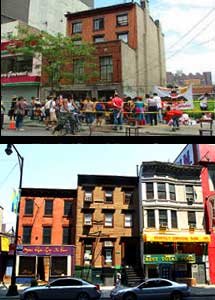
Showing posts with label Underground Railroad. Show all posts

Friday, July 31, 2009

Construction permits pulled at Underground Railroad site

Chelsea Now reports today on the Lamartine Gibbons Home in "Construction permits pulled at Underground Railroad site":

The efforts of a group of preservationists to halt construction work at a Chelsea rowhouse that was a stop on the Underground Railroad recently led the city to revoke the developer’s permits to build a penthouse addition....

Last week, the city Department of Buildings revoked the developer’s construction permit “related to the job to vertically and horizontally enlarge the building,” said DOB spokesperson Carly Sullivan. The plan includes the addition of a fifth floor and penthouse to the 1847 building, with much of the construction already completed despite the fact that it had already been deemed illegal.

In May, the DOB levied a stop-work order on the property, even though ongoing construction work had inexplicably been allowed to continue after the developer’s plans failed a DOB audit in 2008.


For the full article, click here.

According to defenders of the building history, "Although the building permit has been revoked, the architect is apparently still fighting and the owner still has wiggle room to amend the permit before the building is landmarked in the fall."

Saturday, April 11, 2009

An Upstate Underground Railroad Project


I wanted to spread the word about the Underground Railroad History Project of the Capital Region. Here's an introduction from their website:

These pages tell stories about the Underground Railroad in the Capital Region of Upstate New York, and in upstate eastern New York. Why tell that story? First of all because it has been a story that has not received much attention in the general material about the Underground Railroad. Second, it is a story that is important to those of us who live here. But we are telling more than just that story. These pages also focus on the story of the African Americans - both abolitionists and those escaping from slavery whom we call "freedom seekers". It has often been the case in the past that the story of the Underground Railroad was told almost exclusively (with the exception of Harriet Tubman's story) in terms of whites helping African Americans and not often in terms of what African Americans did independently or in leadership roles. These are stories we also focus on. Enjoy the stories recorded in these pages.


Did I mention they have a website? Visit it here.

Monday, March 9, 2009

Photos of hidden space at 231 Duffield

Here are some pictures sent by a reader who identified himself as racer x. The first is an image taken from the ground level from the back of 231 Duffield Street looking down- click the image to enlarge. The wall between 231 and 233 Duffield is on the left:


Here are the pipes in the foreground of the photo above. Notice how they go behind the stone wall towards a brick wall (actual outer wall of property):


The photo below shows the view from above the false wall towards the property line. It shows a gap of about five feet:


Several advocates believe that slaves hid in this crawl space. I have spoken to archeologists familiar with buildings of the mid-19th century, and they had never seen any sort of construction like this.

Wednesday, March 4, 2009

Demolition of Abolitionist home nearly complete


The demolition of 231 Duffield Street continues. The loss of this Abolitionist home was covered in Brownstoner and Curbed. News 12 Brooklyn sent a reporter, but I haven't seen the clip.

To see an annotated Flicker set of photos from 3/4/09, click here. I have included images of other buildings slated for demolition by New York City.

A few people asked for a photo of 231 Duffield Street before demolition began. Here is something I found from about 2005:

Sunday, March 9, 2008

NY Times: Discussing an Underground Railroad museum

The New York Times continues its coverage of the Underground Railroad home on West 29th Street in Manhattan. They published "Retracing the Elusive Footsteps of a Secretive History" on 2/24, and today they published a Letter to the Editor. Here's an excerpt:

In considering the Underground Railroad, people often look at the intake states, such as Ohio and Pennsylvania. However, New York’s role was not only vital but has been often overlooked in the city’s history.

New York was a jumping-off hub. Once escapees reached New York, they could often make a single jump to Canada, on boats going up the Hudson River, or even occasionally on trains.

A museum of abolitionism and the Underground Railroad here would be a welcome tool in teaching tolerance, and a way of illustrating that some New Yorkers reached across barriers of intolerance to help others, at great risk.

For the full letter, click here. Our previous coverage can be found here.

Wednesday, September 12, 2007

Vinegar Hill & the Underground Railroad


In August, District Lines, the publication of the Historic District Council, published a fascinating summary of the history of Vinegar Hill, a neighborhood just north of Downtown Brooklyn and bordering Navy Yards. It touches on history relevant to Duffield Street in this paragraph:

No doubt at least partly because of its proximity to the East River, the neighborhood became a link in the Underground Railroad that provided safe transport to escaping slaves. There could have been another reason, too. The designation report cites 1820 United States Census records documenting 657 free Africans in Brooklyn, about nine percent of the population at the time, which could have made the neighborhood a link not only to the river but to destinations in Brooklyn. One nearby church became a station on the escape route, and a house on Hudson Avenue within the historic district still has a door in its subcellar leading to a tunnel to the waterfront, another link in the train.

The article is not online yet, but you can find other volumes at here. The Historic District Council has a brief description of Vinegar Hill here.

Monday, August 20, 2007

City Gets Go-Ahead To Seize Duffield Homes, Financial Services Firm

The Brooklyn Daily Eagle reports this in "City Gets Go-Ahead To Seize Duffield Homes, Financial Services Firm":
The Department of Housing Preservation and Development ruled today that the city should use its powers of eminent domain to seize 21 properties on three blocks in Downtown Brooklyn — including several homes allegedly involved in the Underground Railroad and Track Data Corporation, a financial services firm that employs 150 people.

As earlier reported in the Eagle, the city plans to raze the Duffield Street homes to build an underground parking garage and one-acre park. Track Data is in the BAM Cultural District, and at the time of the hearing last May, a Downtown Brooklyn Partnership spokesman confirmed that there is no development in any planning or approval stage to replace the firm.

Wednesday, August 15, 2007

Daily Eagle: City plans to commemorate Abolitionism & to raze homes

The Brooklyn Daily Eagle today published "City Promises to Commemorate Abolitionism in Brooklyn, But Still Plans To Raze Duffield St. Homes," which is a probably the best article written on the recent developments. It summarizes some of the valuable contributions that AKRF's report brought to light:
The study, possibly the most extensive documentation of the anti-slavery movement here, noted several hotbeds of abolitionist activity in Downtown Brooklyn and Brooklyn Heights, where prominent abolitionists such as Henry Ward Beecher and William Lloyd Garrison lived. Before the Civil War, the borough, then filled with farmland, also had the highest slave population in New York, and later one of the most successful self-sustaining black communities in the country, Weeksville.
The article also examined the hopes and challenges that Bloomberg's recently announced panel present:

Councilwoman Letitia James, who continues to fight against the destruction of the Duffield Street homes, said she applauds the mayor’s announcement, but “it’s a one-hand clap. They need to go further and preserve these homes.

“I think [the mayor and the Development Corporation] would like to view this as a peace treaty, but it’s not. It doesn’t go far enough,” she said.

Jim Driscoll, a member of the expert panel that reviewed the Duffield Street study who recently submitted an affidavit opposing the seizure of the Duffield Street homes, said at least one should be saved as part of the commemoration effort.

“You have to have a museum if you’re talking about tourism and people coming to see this thing. They’re simply not going to come to see a bunch of signs and a walking tour,” he said. “Basically one of the homes, like 227 Duffield St., would be perfect and that wouldn’t be prohibitively expensive like some of these museums.”

Tuesday, August 14, 2007

Underground Railroad or Underground Rhetoric?

This Plan and collaboration that went into its development underscore the Mayor's commitment that residents should decide the future of their communities," said Deputy Mayor Doctoroff. "Downtown Brooklyn has enormous potential for further quality development and the Administration is determined to ensure that we continue to build consensus going forward so that we meet the needs and interests of everyone involved.
I discussed this quote in June, and it comes from a 2003 press release. It seems like yesterday's press release is a direct continuation of the previous rhetoric of the Bloomberg administration. It is exactly NOT what the New York Post reported:
The Underground Railroad will be officially commemorated in Brooklyn, Mayor Bloomberg said yesterday.
Bloomberg said nothing about commemorating the Underground Railroad— the press release was about the Abolitionist movement. Here's what the press release said about the Underground Railroad:
an extensive research effort was completed in response to suggestions that certain houses on Duffield and Gold Streets in Downtown Brooklyn played a role in the Underground Railroad. The research did not directly connect Underground Railroad activity to the houses, but it did confirm a great deal of abolitionist activity in the area.
and
"Right now, Brooklyn's role in advancing abolitionism and in the Underground Railroad is practically invisible to most New Yorkers," said Councilmember David Yassky. "Today we are making a commitment to make that history more visible, so children can learn its enormously important lessons."
I am greatly encouraged by the new panel announced by Bloomberg. Unfortunately, he did not express any interest in promoting the Underground Railroad history, which seems to be closely linked to 227 Duffield and the surrounding homes.

Bloomberg has been talking about the need to work with the community in Downtown Brooklyn for four (4) years now. Even though he ignored the conclusions of AKRF's Peer Reviewers, and even though he did not consult the Duffield Street stakeholders yesterday, let's hope today is a new day.

If the NYC Economic Development Corporation remains in control, then the Duffield Street Abolitionist homes will be confiscated and destroyed to build a parking lot. If the new panel has some real power, then there is hope to develop Downtown Brooklyn through the promotiong of the Abolitionist history at 227 Duffield.

Monday, August 13, 2007

A victory for Brooklyn or a new justification to demolish the Duffield Abolitionist homes?

This is not a quote from Bloomberg's press release today:
In view of the Underground Railroad’s great importance has in our nation’s history, City Planning and EDC acted immediately to investigate the claims presented at the CPC public hearing of Underground Railroad activity in the area.
This is a quote a NYC Department of City Planning press release from 2004.

The Observer reports on a new released press release (PDF) in Mayor Appeases on Underground Railroad Rancor. Here is an excerpt:
MAYOR BLOOMBERG ANNOUNCES PROJECT TO RECOGNIZE BROOKLYN'S ROLE IN 19TH CENTURY ABOLITIONIST MOVEMENT

Widely Respected Panel Selected to Assist with Commemoration Project

Mayor Michael R. Bloomberg today announced plans to develop a project to commemorate abolitionist activity that occurred in Brooklyn in the 1800s. To assist in that effort, a six-member panel of noted historians, community leaders and academics has been selected to work with the City and the Downtown Brooklyn Partnership.

"Recognizing and honoring the historic role that Brooklyn played in the abolitionist movement is a worthy endeavor, and a role we should be proud of," said Mayor Bloomberg. "It's important that as we work to bring new jobs and housing to downtown Brooklyn that we also work to ensure that the noteworthy deeds of our ancestors will not be forgotten.
The announcement is certainly a victory for those who want to promote the development of Downtown Brooklyn through the commemoration of the Abolitionist history at 227 Duffield Street and other nearby historic properties. It is a clear recognition by the Mayor that these buildings can provide an important cultural resource to the area.

It remains to be seen whether today's press release is just an excuse to tear down these properties and to build a memorial at some other location. The EDC made this suggestion at the May 1st 2007 public hearing on the historical claims surrounding the Duffield Street homes threatened with destruction by their Downtown Brooklyn plans.

There are some disturbing hints in the Mayor's press release. Most strikingly, the EDC hired a team of eminent historians to act as Peer Reviewers for the report written by AKRF and published by the EDC in March 2007. These academics worked to legitimize the AKRF report, which concluded that there was not sufficient evidence at the time to preserve the properties. The Peer Reviewers came to the conclusion that the properties should be preserved.

Today's press release announces a "Widely Respected Panel Selected to Assist with Commemoration Project," but none of the Peer Reviewers who spoke out against the EDC's conclusions were included. Apparently, their years of work on the subject mean that they are no longer "widely respected," since they disagreed with the EDC.

It is also quite curious that the Mayor did not include Four Borough Neighborhood Preservation Alliance as one of the community groups on his panel. Four Borough has been at the forefront of the initiative to advocate for Downtown Brooklyn through the promotion of the history at 227 Duffield Street and nearby properties.

The press release continues:
In connection with the City's efforts to implement the Downtown Brooklyn Plan... an extensive research effort was completed in response to suggestions that certain houses on Duffield and Gold Streets in Downtown Brooklyn played a role in the Underground Railroad. The research did not directly connect Underground Railroad activity to the houses, but it did confirm a great deal of abolitionist activity in the area. As a result, the City is seeking to develop a commemoration program that will celebrate and embrace the role that Brooklyn played in bringing an end to slavery.
AKRF did spent two years researching this history, but for serious academic research, this is just scratching the surface. And it is factually incorrect to say that this effort "was completed in response to suggestions" etc. The research was done because AKRF was caught lying. The well respected historian Dr. Cheryl LaRoche testified before the City Council that Duffield Street is the most promising site for Underground Railroad research in the country. It is wrong to characterize this as a mere "suggestion," and I hope the Mayor corrects this error.

We applaud the Mayor for moving in the right direction. We just hope it is the right direction.

Friday, July 27, 2007

Newly Released Evidence of Buildings Communicating


AKRF had to do some dances to try to disprove that the Duffield Street Abolitionist homes never sheltered escaped slaves. Nobody denies that well-known Abolitionists lived there, and one neighborhood reporter, Walt Whitman, wrote about an escaped slave coming to his home in Leaves of Grass.

For some reason, AKRF found it problematic that the buildings communicated- which in this case means that there were underground tunnels connecting them. Various sources, including NoLandGrab.org report that the 2007 AKRF report published an 1855 map of Duffield, but left out the key to the map. Even though AKRF spent 2 1/2 years researching the Duffield Street history, they failed to hire an architect to study the site, even though they have one on staff.

Despite AKRF's denials, it certainly looks to me that the basement of 227 Duffield used to have a passageway connecting it to 225 Duffield. I have posted images and a video that show that most of the basement was constructed with stone, except for a small portion on the front part of the northern wall.

For photos, click here.

For the video, click here.

Saturday, July 14, 2007

Duffield Street Neighborhood Gains Ground

The Duffield Street Abolitionist Abolitionist homes continue to get national attention. The July 2007 edition of the Underground Railroad Free Press reports:

Late-Breaking News

Duffield Street Neighborhood Gains Ground

This historic New York City area, threatened
with destruction by a developer, is mounting
a multifront attack helped by recruiting key
elected officials to its cause. A trumped-up
historical report has been debunked and City
officials are having another look.

Click here to download the full PDF.

Wednesday, June 27, 2007

The First White House


The archaeological discovery of slave passages at George Washington's presidential home has created quite a stir. You can read about it here and here. There's an interesting connection between that discovery and the new interest in the Abolitionist homes on Duffield and Gold Streets in Brooklyn. Dr. Cheryl LaRoche has been instrumental in both projects. She was hired by AKRF as a Peer Reviewer in their report on Duffield released in March. Dr. LaRoche, like many of the academics hired by AKRF, came to the conclusion that the Abolitionist homes in Brooklyn should be preserved since they represent one of the best opportunities for Underground Railroad research in New York. These conclusions were published by the NYC Economic Development Corporation, and can be found by clicking here and going to Appendix C.

Sunday, June 24, 2007

Abolitionist Museum Augments the Stated Bloomberg Vision

On June 23, 2007 the Daily News started an opinion piece with this statement:


The future of downtown Brooklyn is colliding with its past. Unsubstantiated claims that six 19th-century houses may have hidden slaves on the Underground Railroad are being used to block a key component of the area's rebirth.
But a quick look at the stated goals of the plan will show that an Abolitionist museum at 227 Duffield Street would greatly augment the stated goals of the plan for Downtown Brooklyn. Here are a few quotes from a Department of City Planning press release "Bloomberg Administration Unveils Development Plan for Downtown Brooklyn (4/13/2003)" [emphasis added]:
  • Downtown Brooklyn offers companies seeking to diversify their operations affordable office space, outstanding mass transportation access, and burgeoning residential, academic and cultural opportunities
  • Downtown Brooklyn must be a livable community with its own unique identity
  • Our vision for Downtown Brooklyn capitalizes on its existing strengths: its transit networks, strong neighborhoods, cultural resources
  • The plan calls for... an expanded intellectual community.... [and] A mixed-use cultural district with a new library, theaters, galleries, rehearsal spaces, and other cultural venues
  • "This Plan and collaboration that went into its development underscore the Mayor's commitment that residents should decide the future of their communities," said Deputy Mayor Doctoroff. "Downtown Brooklyn has enormous potential for further quality development and the Administration is determined to ensure that we continue to build consensus going forward so that we meet the needs and interests of everyone involved."
The press release mentions the word "cultural" eight times, and "parking" twice. The plan would call for the creation of 2,000 new parking spaces, and 694 of those were envisioned for the properties currently home to the Chatel and other families.

The promotion of an Abolitionist museum on Duffield Street is much more consistent with the stated goals of the Department of Planning press release. The future of Brooklyn is not colliding with its past. We need to fully research the historical these properties before destroying them. Otherwise, it might be the parking lot that will "block a key component of the area's rebirth."

But who's listening?

Our Times Press published a summary of the May 22nd Eminent Domain hearing. See


The article quotes Christopher Moore at length:

"Within a stone's throw of Duffield Street, you have financiers, Arthur and Lewis Tappan on Pierrepont Street. In 1835, Lewis financed the great postal campaign which sent antislavery materials throughout the country. Congress, flooded with petitions, adopted the first slavery gag rule. That campaign started in Brooklyn."


"Half a block away at Willoughby and Duffield Streets, William Harned is purchasing land in the Adirondacks for fugitive slaves. Go another half a block and Walt Whitman, fired from the Brooklyn Eagle for writing antislavery editorials, is forming an abolitionist newspaper at the corner of Myrtle Avenue. At 227 Duffield, Harriet Truesdell involves herself in anti-slavery campaigns at a time when it was dangerous for white women to do so."


Saturday, June 23, 2007

Daily News Calls Grassy Knoll Key to Brooklyn Economy

An attempt to discredit historical evidence of
Abolitionist and Underground Railroad Activity


Finally a newspaper has tried to defend the Economic Development Corporation attempt to confiscate and demolish the seven homes linked to the Abolitionist movement in Downtown Brooklyn. The opinion piece, Taking license with slavery, published June 23, 2007, makes several strong claims and challenges the motivations of those trying to promote the Abolitionist heritage.

“A Key Component of the Area’s Rebirth”?

The thesis of the article is that preservationists are trying to “block a key componenent of the areas’ rebirth.” Unfortunately, the Daily News fails to explain why these properties are “a key component.” It would be very interesting to hear how this proposed grassy knoll is essential to Brooklyn’s economy.

Given the lack of specifics by the Daily News, I am reminded of the exact same claims by the EDC in the City Council hearing on the subject of May 1, 2007. At the hearing, Council Representative Liu spent several minutes trying to ask the EDC representative if, in fact, the Downtown Brooklyn plan could proceed without this property. EDC Vice President Thomas McKnight tried to avoid anwering Liu’s yes-or-no question, but in the end, he admitted that the EDC plan can proceed without the properties.

The Daily News itself gives many examples of how Downtown Brooklyn is experiencing astounding economic development without a grassy knoll and parking lot at the site of these seven homes. In their words, “Billions of private dollars have been committed to projects ranging from skyscrapers to affordable housing.”

It's possible that another parking lot would also greatly help Downown Brooklyn, but why is eminent domain necessary for this? If the two impressive new hotels going up across the street from 227 Duffield need parking, why can't they build it themselves?

Let me make a simple request of the Daily News. Please explain how these billions of dollars of investments are threatened by the Duffield Street Seven?

Independent Research?

Given the weak argument of the benefits of destroying these privately owned homes and businesses, the Daily News goes on to attack the defenders of the Abolitionist homes. In response to advocates' claims that the EDC "failed to adequately research the possibility that the buildings once harbored runaway slaves," the article states:

"In fact, the city bent over backward to do just that, commissioning a $500,000 study by independent researchers and historians. The conclusion: A family active in the abolitionist movement once lived there, but there is no proof the houses hid fugitives. [emphasis added]

The City may have bent over backward, but that doesn't mean they successfully proved their point. The EDC hired AKRF to do this research, and AKRF was hired without competitive bidding. This raises questions about their independence, especially since AKRF has never said who the "independent" researchers are. The EDC report published in March 2007 and written by AKRF, goes into great detail about the qualifications of the historians hired as peer reviewers. But these well-respected academics were only reviewing the work of the researchers who wrote the report. Nowhere does AKRF or the EDC name the researchers. Only AKRF can say what their qualifications are, and whether they are in fact independent. But AKRF is not speaking, and the EDC is not asking.

The Daily News article parallels the EDC’s attempt to frame the historical discussion. There is no debate that the area around Duffield Street was a known Abolitionist neighborhood at a time when most of New York was pro-slavery. One local resident, a poet and reporter named Walt Whitman, wrote vividly about an escaped slave coming to his house in a book called Leaves of Grass (1855). The Daily News and the EDC try to fall back on the argument that there is no verifiable evidence that slaves hid in the basements of these properties. The Underground Railroad was a very secretive movement, and the EDC does not claim that slaves did not hide in these basements. It only says that there is no proof that they did.

The historians hired by AKRF did come to the conclusion that the properties should be preserved. The EDC conclusion contradicts the peer reviewers published statements calling for further research. Even the Executive Summary of the AKRF/EDC admits that more evidence of Underground Railroad activity could be discovered.

Historians like Dr. Cheryl LaRoche, who was hired by AKRF to legitimize their report, have dedicated their lives to researching the Abolitionist movement and the Underground Railroad. Dr. LaRoche, who is much more respected in this field than the EDC or the Daily News, has stated that Duffield Street represents the best site for possible Underground Railroad in New York City. She says that it is one of the most promising sites that she has ever evaluated.

Nobody debates that this is the best documented potential Underground Railroad site in New York City.

Even if it is impossible to prove that fugitive slaves hid in the basement, the homes still might be an important part of Abolitionist history.

Representatives Liu, James and Barron are not denouncing the report “simply because they say so.” You could almost say that the report denounces itself. Its Executive Summary seems to contradict the Appendices.

Working Together to Promote New York

The EDC’s stated goal is to have a diverse and vibrant economy. A parking lot may attract a few people, but in the long run, the New York economy would be better off with a museum for our proud Abolitionist history on Duffield Street.

The Daily News says that promoters of Abolitionist history are "cynically playing on the charged issue of the city's slave past." If the Daily News has to resort to this sort name-calling, then it looks like the argument in favor of the parking lot is weak. If the EDC is going to confiscate possibly historic private property, the burden of proof of the benefit must be high.