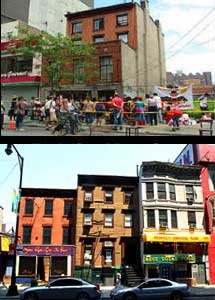
The city Landmarks Preservation Commission enthusiastically approved the historic designation of a dozen neighboring buildings on W. 29th St. that played a pivotal role in New York’s abolitionist history.The Lamartine Place Historic District—which includes a row house that acted as a stop on the Underground Railroad among 12 contiguous properties between Eighth and Ninth Aves.—received unanimous support from the commission, which credited the work of local advocates in pushing for the designation.“There’s no question that, in my mind, since the first time that this was brought to our attention, there’s an incredibly committed neighborhood group—residents and committed neighbors—who have helped really lead this fight,” said LPC Commissioner Robert Tierney in his remarks, citing the “enormously important history” of the properties. “We live in New York City, and we sometimes don’t see our history as well and as clearly as we should,” he added. “I think this helps clarify that.”
Showing posts with label Abolitionist History. Show all posts
Showing posts with label Abolitionist History. Show all posts
Wednesday, October 14, 2009
Abolitionist homes saved!!
The Underground Railroad homes on West 29th Street in Manhattan have gotten historic protection from the Landmark Preservation Commission. Here is the an excerpt from "Landmark victory for Underground Railroad block" published in Chelsea Now:

Thursday, February 28, 2008
Retracing the Elusive Footsteps of a Secretive History
 The NY Times published an article on the challenges of preserving homes tied to the Underground Railroad. Sound familiar? This is a story that takes place not in Brooklyn, but in Manhattan, on West 29th Street, also known as Lamartine Place.
Here is a quote from Retracing the Elusive Footsteps of a Secretive History:
Though buildings throughout the city are often thought to have been part of the escape route north, finding documents that provide proof is extremely difficult. “It’s incredibly rare that you can substantiate it,” said Andrew Berman, executive director of the Greenwich Village Society for Historic Preservation. “Locations were secretive by their very nature.”
Despite the documentation Ms. Luskin collected, No. 339 could not originally be considered for designation as a landmark because a building permit had been issued for the construction project. However, construction is at a standstill; according to Kate Lindquist, a spokeswoman for the Department of Buildings, the permit for construction of the penthouse is being revoked, in part because an agency review determined that the architectural plans did not comply with building and zoning codes.
The Landmarks Preservation Commission is currently evaluating No. 339 to see if it is eligible for designation as a landmark, news that will no doubt delight some local residents.
“Being one of the few African-Americans on the block, I have an emotional connection to this history,” said Curtis Jewell, a 55-year-old truck driver for the Postal Service who has lived in Ms. Luskin’s building for 10 years. “You have a lot of cultural history in New York that money seems to want to push out of the way.”
Monday, February 18, 2008
African American PlayWrights Exchange spreads the word about Duffield
 The African American PlayWrights Exchange is helping to spread the word about our upcoming fundraiser:
227 Abolitionist PlaceTo visit their blog, please click here.
Home of Brooklyn’s Abolitionist Movement
Help support the creation of an Independent museum/cultural center for the celebration of American history and Brooklyn’s resistance to slavery
Friday, February 29th
7:00 to 10:00 PM
at
Danny Simmons'
Corridor Gallery
Monday, December 24, 2007
AM New York: Rescue Us
 AM New York has put preserving New York's urban heritage on the front cover of the December 21-23 edition. The prominent treatment suggests that there is widespread support for keeping the unique features of New York City. Number Four on the AM New York's list is Duffield Street:
Development pressures in downtown Brooklyn threaten the existence of several houses possibly linked to the Underground Railroad. Preservationists say the city ignored documents detailing the historical significance of the houses on Duffield Street.It's good to hear that the homes on West 29th Street are also getting some news coverage. It's also good to report (contrary to the quote above) that 233 Duffield is not threatened. The owner is not selling, and the home is not threatened with eminent domain.
After nearly four years of protest, one of the homes, No. 227, has been saved. But the fate of others on the street (Nos. 231 and 233) is up in the air. They're slated for demolition as part of a major redevelopment project for Willoughby Square.
Also on watch: The 1847 James Sloan and Abigail Hopper Gibbons home in Chelsea (339 W. 29th St.). Newspaper editor Horace Greeley and abolitionist John Brown were known to stay here, and the house was specifically targeted during the 1863 Draft Riots. Community Board 4 is advocating its preservation: the current owner is remodeling and wants to add a penthouse.
Friday, October 12, 2007
NY Times prints big article on Duffield and the Underground Railroad

The New York Times published an extensive article on the Underground Railroad in Brooklyn, which explores the Duffield Street homes, and their connection to the rest of Brooklyn at the time. To read the article and see the accompanying video, go to On the Trail of Brooklyn's Underground Railroad
The Times explores some of the context of Duffield Street:
The article mentions the failure to find conclusive proof of Underground Railroad activity:From Plymouth Church, it’s a 10-minute walk to the corner of Fulton and Duffield Streets, where the new Abolitionist Place sign hangs. The abolitionists Thomas and Harriet Truesdell lived at 227 Duffield Street in the 1850s, and William Harned, an Underground Railroad conductor, lived near Duffield and Willoughby Streets.
Even as the city unveiled the new sign, however, it was considering plans to demolish the small houses on Duffield Street as part of an economic development plan for downtown Brooklyn. New hotels, underground parking and a public square would replace much of what now stands on the block.
While maintaining a sense of balance, the article makes a very strong case for further research into the historical significance of the Duffield Street homes.Mr. Greenstein acknowledged that they have only circumstantial evidence. A planning and environmental firm commissioned by the city found no conclusive proof of their claims. The consultants made no attempt to excavate that mysterious tunnel, noting in their report that “assuming that a tunnel was discovered, there would be no way of knowing if it served as a passageway for freedom seekers without corroborating artifacts.”
Still, Mr. Greenstein said, “I think there’s enough evidence here to say, ‘Let’s do an archaeological dig.’”
Wednesday, September 19, 2007
Tomorrow: Duffield Street co-named as Abolitionist Place
Duffield Street between Fulton and Willoughby will be co-named Abolitionist Place tomorrow at 1pm. More info to come!


Sunday, September 9, 2007
Beecher's Bibles
 The Brooklyn Rail just published "The Case Of The Duffield Street Homes." The article discusses current issues, and says this about the Truesdell family, 19th century residents of 227 Duffield:
Thomas and Harriet Truesdell were veterans of the abolitionist movement by the time they moved from Rhode Island to Brooklyn in 1850. Thomas was a delegate to the 1836 Rhode Island Anti-Slavery Convention. He donated to the American Anti-Slavery Society, and subscribed to the National Anti-Slavery Standard. His wife, Harriet, sat on the planning committee of the 1838 Anti-Slavery Convention of American Women.The article also describes the physical evidence that didn't fit into the city's narrative. For more images of the basement and their significance, click here.
The Truesdell’s neighbors included officers in the Underground Railroad and the anti-slavery New York State Vigilance Committee, and other abolitionist eminences such as William Lloyd Garrison and Reverend Henry Ward Beecher. The guns that the Reverend was then sending to anti-slavery militias in Missouri, Kansas and Nebraska were called “Beecher’s Bibles.”
Sunday, August 26, 2007
amNY: Will Duffield Houses be railroaded?
 Promoting the Abolitionist history of Duffield Street reached huge milestone today: It has received front-page coverage by a widely-read city newspaper. "Will Duffield Houses be railroaded?" (amNewYork 8/27/07) includes many new photos and video. It is the first published interview of a member of Bloomberg's much-criticized new panel to commemorate Abolitionist history in Brooklyn:
One member of the panel, Richard Greene, executive director of the Crown Heights Youth Collective, said he is hopeful some way can be found to preserve the evidence of the Underground Railroad, perhaps even incorporating parts of Greenstein¹s basement into the final design."It's just too important a moment in our history to let it be sidelined," Greene said.
To see the video, click here.
Thursday, August 16, 2007
City announces RFP to destroy Duffield Abolitionist homes
The Brooklyn Daily Eagle today published "City Seeks Developer for Downtown Park, Garage", which starts:
The city officially began seeking a developer for the “Willoughby Square” park and underground garage on Monday, the same day Mayor Michael Bloomberg announced a $2 million project to commemorate abolitionist activity in Downtown Brooklyn.The Abolitionist homes and the potential Underground Railroad sites would be destroyed in order to create a parking lot and grassy knoll. The project would also require the use of eminent domain to confiscate the properties, since the owners do not want to sell. The owners want to create an Abolitionist museum on the site. The article notes that HPD's decision on the Duffield homes is due next week and it continues:
The requests for proposals notes that the process of acquiring the site may increase “by approximately one year” before construction can proceed if condemnation proceedings are necessary.
When completed, city officials have said, the project would be a key component of the city’s effort to revitalize downtown, providing much-needed parking and open space to the thousands of new residents, office workers and shoppers expected to pour in as dozens of planned projects surrounding the site take shape.
Wednesday, August 15, 2007
Brooklyn Star: Preserving Brooklyn's Abolitionists
The Brooklyn Downtown Star reports on Bloomberg's newly announced Abolitionist panel. Unlike the NY Post or NY Times, the Brooklyn-based papers bother to pick up the phone and talk to people. Here is an excerpt from "Preserving Brooklyn's Abolitionists":
"I think it [the panel] is a good idea, but it doesn't go far enough to preserve the homes on Duffield Street," said Councilwoman Letitia James. "I applaud the administration with one hand."
James has filed a brief in support of a lawsuit filed by residents on Duffield Street to block the seizure of their homes. "I already told the administration that I will continue to advocate for the homes in the Downtown Brooklyn Plan," she said.
One of those residents is Joy Chatel, who lives at 227 Duffield Street, and first heard of the new panel when contacted for this article.
"That's absolutely horrible," she said. "Why is the local community always shut out?"
Subscribe to:
Posts (Atom)